


The MI value can be interpreted in a number of equivalent ways:
(i) The MI is the reduction in uncertainty about the stimulus
after a response is observed. This is the standard
information-theoretic interpretation. In the context studied here,
without observing the response, the stimulus can be any one of the
 stimuli, resulting in an uncertainty that is quantified by the
entropy of the set of stimuli, here equal to
stimuli, resulting in an uncertainty that is quantified by the
entropy of the set of stimuli, here equal to
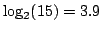 bits. If
the mutual information between a neuron and the stimuli is e.g. 0.5
bit, observing the responses of the neuron reduces this entropy to
3.4. bits. Thus, the a-posteriori distribution over possible stimuli
is less variable than the initial distribution. Observing more
non-redundant neurons would reduce this uncertainty even more. If the
uncertainty about the stimulus is
bits. If
the mutual information between a neuron and the stimuli is e.g. 0.5
bit, observing the responses of the neuron reduces this entropy to
3.4. bits. Thus, the a-posteriori distribution over possible stimuli
is less variable than the initial distribution. Observing more
non-redundant neurons would reduce this uncertainty even more. If the
uncertainty about the stimulus is  , the stimulus is known with
precision. Thus, theoretically, the responses of
, the stimulus is known with
precision. Thus, theoretically, the responses of  totally
non-redundant neurons, each with 0.5 bit/stimulus, are sufficient to
fully specify the stimulus. I practice, neurons may be redundant and
the actual number of neurons required to uniquely identify the
stimulus may be substantially higher.
totally
non-redundant neurons, each with 0.5 bit/stimulus, are sufficient to
fully specify the stimulus. I practice, neurons may be redundant and
the actual number of neurons required to uniquely identify the
stimulus may be substantially higher.
(ii) The MI is the  of the number of different classes to
which the stimuli can be subdivided after observing a response. This
interpretation is tightly linked to the previous one, and is a
concrete interpretation of the reduction in uncertainty.
of the number of different classes to
which the stimuli can be subdivided after observing a response. This
interpretation is tightly linked to the previous one, and is a
concrete interpretation of the reduction in uncertainty.
(iii) The MI quantifies the differences between the responses to
the various stimuli. The MI can be formally written as the the
average divergence between the distribution of responses to a specific
stimulus and the unconditional response distribution (superposition of
the individual distributions to each of the specific stimuli). The
divergence used here is the Kullback-Leibler (KL) divergence,
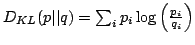 . Thus, if the responses are independent of the stimulus,
responses to any of the stimuli will be very similar (up to sampling
issues) to the average distribution, and the KL distance will be
small, resulting in a low MI. Conversely, when the responses strongly
depend on the stimulus, the average response distribution is largely
different from the response distribution to any specific stimulus, and
as a result the KL distance is large and so is the MI.
. Thus, if the responses are independent of the stimulus,
responses to any of the stimuli will be very similar (up to sampling
issues) to the average distribution, and the KL distance will be
small, resulting in a low MI. Conversely, when the responses strongly
depend on the stimulus, the average response distribution is largely
different from the response distribution to any specific stimulus, and
as a result the KL distance is large and so is the MI.
In this view, the MI quantifies the stimulus effects on the responses. This view is closer to standard statistical tests such as 1-way ANOVA (that tests stimulus effects on the mean responses, assuming equal variance). However, standard statistical tests often have strong assumptions on the distributions of the responses, whereas the MI can be interpreted without any distributional assumptions.