

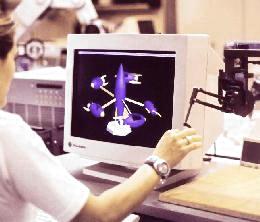
 The human sense of touch is an indispensable tool in allowing us
to manipulate and interact in our every-day world. This intuitive
form of interaction, however, is often absent when working in remote or
virtual environments. Haptic systems have demonstrated the capability
of re-introducing this lost ability into computer/user interfaces.
These force-feedback systems, by simulating the forces caused by the
virtual environment, augment the amount of information that can be
presented to the user by visual means alone, as well as increase
the sense of immersion experienced by the user.
The human sense of touch is an indispensable tool in allowing us
to manipulate and interact in our every-day world. This intuitive
form of interaction, however, is often absent when working in remote or
virtual environments. Haptic systems have demonstrated the capability
of re-introducing this lost ability into computer/user interfaces.
These force-feedback systems, by simulating the forces caused by the
virtual environment, augment the amount of information that can be
presented to the user by visual means alone, as well as increase
the sense of immersion experienced by the user.
Our research has focused on the development of algorithms and control
structures to allow the quick and robust tactile display of virtual
environments derived from common graphical descriptions. The development
of this technology has the potential for enormous benefits in many areas
of human activity including medicine, industrial design, aeronautics,
robotics, and education.
 Diego C. Ruspini, ruspini@cs.stanford.edu
Oussama Khatib, khatib@cs.stanford.edu
Diego C. Ruspini, ruspini@cs.stanford.edu
Oussama Khatib, khatib@cs.stanford.edu


| Ruspini, Diego, Oussama Khatib, "Dynamic Models for Haptic Rendering Systems." Advances in Robot Kinematics: ARK'98, June 1998, Strobl/Salzburg, Austria, pp523-532. available as Postscript(1.5MB) |
|
| Ruspini, Diego, "Adding Motion to Constraint Based Haptic Rendering Systems: Issues & Solutions." Second PHANToM User's Group Workshop, October 19-22, 1997, Dedham, MA. link PUG'97 |
|
| Ruspini, Diego, Krasimir Kolarov, Oussama Khatib, "The Haptic Display of Complex Graphical Environments." SIGGRAPH 97 Proceedings, (August 1997), pp. 345-352. available as Postscript(4.5MB) or Acrobat(386K) |
|
| Ruspini, Diego, Krasimir Kolarov, Oussama Khatib, "Haptic Interaction in Virtual Environments." IEEE/RSJ International Conference on Intelligent Robots and Systems: IROS'97, September 1997, Genoble, France. available as Postscript(1.5MB) or Acrobat(225K) |
|
| Ruspini, Diego, Krasimir Kolarov, "Graphical and Haptic Manipulation of 3D Objects." First PHANToM User's Group Workshop, September 27-30, 1996, Dedham, MA. link PUG'96 |




 Diego C. Ruspini
(ruspini@cs.stanford.edu)
Diego C. Ruspini
(ruspini@cs.stanford.edu)